GDPR compliance, audit readiness, and data privacy are increasingly shaped by the AI tools organizations adopt. For compliance and privacy managers, the question is no longer whether AI will touch your data strategy but how deeply it already has.
Every automated decision, every machine learning model trained on personal data, and every AI-powered analytics dashboard introduces new privacy risk vectors that traditional assessment frameworks weren't built to handle. The stakes are high: GDPR fines reached record levels in 2023, with Meta alone paying €1.2 billion for cross-border data transfer violations.
A structured checklist approach to evaluating AI's privacy impact is no longer optional. This guide walks you through four practical steps to align your AI tool usage with a robust, audit-ready data privacy strategy. For a broader foundation on what this alignment looks like in practice, our complete guide on AI privacy compliance covers the core principles you need to understand first.
Key Takeaways
- Map every AI tool that processes personal data before building your privacy strategy.
- Conduct a dedicated privacy risk assessment for each AI system you deploy.
- Update your GDPR compliance checklist to include AI-specific processing activities and safeguards.
- Build audit trails that capture AI decision logic, not just inputs and outputs.
- Train your team on AI-specific privacy obligations to reduce human error exposure.

1. Map Every AI Tool Processing Personal Data
The first step is deceptively simple but consistently overlooked: know exactly which AI tools in your organization touch personal data. Shadow AI is a real problem. Departments adopt chatbots, transcription services, AI-powered CRMs, and predictive analytics platforms without informing the privacy team. A 2024 Cisco survey found that 27% of organizations had banned certain generative AI tools internally, yet employees continued using them. You cannot protect data you don't know is being processed.
Start by surveying every department. Ask specifically about AI-powered features embedded in existing software, not just standalone AI products. Your marketing team's email platform likely uses machine learning for send-time optimization. Your HR software probably scores candidates using algorithmic assessments. These are AI processing activities under GDPR's scope, and they require documentation in your Records of Processing Activities (ROPA).
Build Your AI Data Inventory
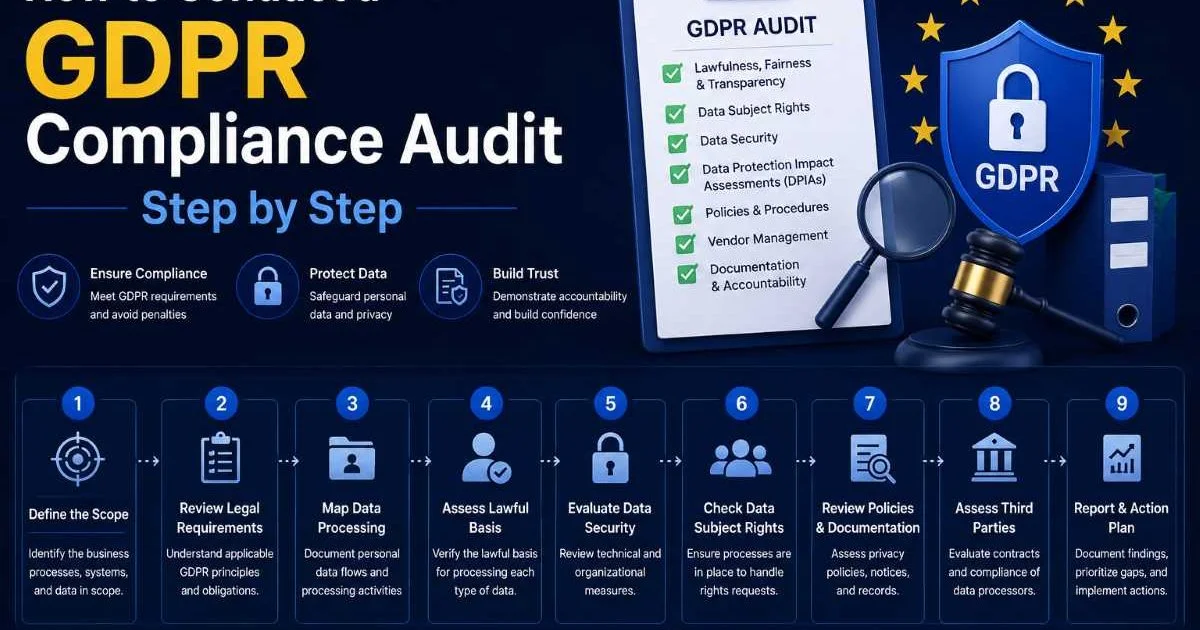
Create a structured inventory that captures the tool name, vendor, data categories processed, legal basis, data residency, and whether automated decision-making (Article 22) applies. This inventory becomes the backbone of your privacy strategy. Without it, your compliance audit will have blind spots that regulators will find before you do. For a step-by-step methodology on building this foundation, the guide on how to conduct a GDPR compliance audit provides a detailed walkthrough.
Schedule quarterly AI tool discovery surveys with department heads to catch new tools before they become compliance gaps.
Don't forget third-party AI integrations. When your customer support platform routes tickets using AI, the vendor is likely a data processor under GDPR. Review their Data Processing Agreements (DPAs) for AI-specific clauses around data retention, model training, and sub-processor chains. Many SaaS vendors use customer data to train their models unless you explicitly opt out. This single oversight has triggered multiple GDPR enforcement actions across the EU.
2. Conduct AI-Specific Privacy Risk Assessments
Traditional Data Protection Impact Assessments (DPIAs) were designed for straightforward data processing. AI introduces probabilistic outputs, opaque decision logic, and training data risks that require expanded assessment criteria. Article 35 of the GDPR mandates a DPIA whenever processing is "likely to result in a high risk" to individuals. Nearly every AI system processing personal data at scale meets this threshold. Our dedicated resource on privacy risk assessment for AI systems breaks down the specific criteria you should evaluate.
Scoring AI Privacy Risks
Evaluate each AI tool against five risk dimensions: data minimization compliance, transparency of logic, accuracy of outputs, potential for discrimination, and data security posture. Score each dimension on a scale from low to critical. A hiring algorithm that screens candidates based on historical data, for example, may score high on discrimination risk but low on data minimization if it only processes relevant fields. This granular scoring helps you prioritize remediation.
Pay special attention to AI tools that make or recommend decisions affecting individuals. Credit scoring algorithms, insurance pricing models, and employee performance systems all require explainability under GDPR. If a data subject exercises their Article 22 rights and asks why an AI denied their application, you need a documented, understandable answer. "The algorithm decided" is not a legally valid response. Build your assessment to capture whether each tool can generate meaningful explanations.
AI tools that cannot explain their decision-making logic may violate Article 22 GDPR requirements for automated decision-making transparency.
Database and infrastructure security also deserve attention during your risk assessment. AI tools often require access to centralized data stores, and a breach at the database level can expose every dataset the AI touches. Following established database security best practices will reduce the attack surface significantly. Encrypt data at rest and in transit, enforce least-privilege access controls, and audit query logs from AI services regularly.
3. Update Your GDPR Compliance Checklist for AI
Most GDPR compliance checklists were written before generative AI became mainstream. If your checklist doesn't include items for algorithmic transparency, model training data governance, and AI vendor assessments, it's incomplete. The gap between pre-AI checklists and current regulatory expectations is where GDPR fines materialize. Ireland's DPC, France's CNIL, and Italy's Garante have all published AI-specific guidance that should inform your updated checklist. Review our GDPR checklist for data privacy teams in 2024 for a comprehensive starting framework.
AI Additions to Your Audit Workflow
| Checklist Item | GDPR Article | Priority |
|---|---|---|
| Document AI processing in ROPA | Article 30 | High |
| Complete DPIA for high-risk AI systems | Article 35 | High |
| Verify lawful basis for AI model training | Article 6 | High |
| Implement AI explainability for automated decisions | Article 22 | Critical |
| Review AI vendor DPAs for model training clauses | Article 28 | Medium |
| Establish AI-specific data retention schedules | Article 5(1)(e) | Medium |
| Enable data subject access for AI-processed data | Articles 15-20 | High |
| Test AI outputs for bias and discrimination | Recital 71 | High |
Integrate these items into your existing audit workflow rather than creating a separate AI compliance track. Siloed compliance processes inevitably fall out of sync. When your auditor reviews consent management, they should simultaneously verify that consent covers AI-specific processing purposes. When they review data retention, they should check whether AI model weights or embeddings derived from personal data are included in deletion schedules.
AI model weights trained on personal data may constitute personal data themselves under certain interpretations, requiring their own retention and deletion policies.
Consider automating parts of your compliance checklist. Ironically, AI can help here. Natural language processing tools can scan privacy policies and DPAs for missing AI clauses. Automated scanning of your data infrastructure can flag AI tools accessing personal data stores without proper authorization. The key is using AI to strengthen your GDPR compliance posture without introducing new unmanaged risks. Every compliance automation tool you adopt should itself go through the same vetting process outlined in steps one and two.
"The gap between pre-AI compliance checklists and current regulatory expectations is exactly where GDPR fines materialize."
4. Build Audit Trails and Train Your Team
When a supervisory authority investigates your AI processing activities, they will request documentation. Not just your policies, but evidence that those policies were followed. This means logging AI system inputs, outputs, configuration changes, and access events in a tamper-resistant format. Time-stamped audit trails that demonstrate continuous compliance are far more persuasive than a binder of policies that may or may not reflect actual practice. Build these trails into your AI tools from day one, not after an incident.
Version control your AI models and document every retraining event. When a model is retrained on new data, log the data sources, the date, the personnel who authorized it, and any changes to the model's behavior. If a data subject later challenges a decision made by a previous model version, you need to reconstruct what that version knew and how it reasoned. This level of documentation may feel excessive, but it's exactly what regulators expect when GDPR fines are on the table.
Documentation That Survives Regulatory Scrutiny
Team training is the other half of this equation. Your privacy team needs to understand how AI systems work well enough to spot compliance gaps. This doesn't mean everyone needs a machine learning degree, but they should understand concepts like training data, inference, model drift, and data leakage. Run practical workshops where team members evaluate a real AI tool against your updated checklist. Hands-on exercises build far better judgment than slide decks.
Create a one-page AI privacy decision tree that any team member can use to determine whether a new AI tool needs a DPIA before adoption.
Extend training beyond the privacy team. Procurement staff should know which AI-specific clauses to require in vendor contracts. Product managers should understand when a new feature triggers an Article 35 DPIA. Department heads should know how to report new AI tools to the privacy office. Distributed awareness is your most effective defense against the compliance gaps that lead to regulatory scrutiny and potential GDPR fines. Make AI privacy literacy part of onboarding, not just annual refresher training.

Frequently Asked Questions
?How do I add AI tools to my existing ROPA documentation?
?Is a standard DPIA enough for AI systems, or do I need something different?
?How much time does a quarterly AI tool discovery survey realistically take?
?Does banning generative AI tools actually reduce GDPR exposure?
Final Thoughts
AI tools are already woven into your data processing landscape, whether you've formally accounted for them or not. The four steps above give compliance and privacy managers a practical path forward: map your AI tools, assess their risks, update your GDPR compliance checklist, and build the audit trails that prove your diligence.
None of this is theoretical. Regulators are actively investigating AI processing activities, and the organizations that have done this work will be the ones that avoid costly enforcement actions. Start with step one this week; your future self, and your DPO, will thank you.
Disclaimer: Portions of this content may have been generated using AI tools to enhance clarity and brevity. While reviewed by a human, independent verification is encouraged.