A GDPR compliance audit is the most effective way to identify where your organization stands on data protection and what gaps need fixing before regulators come knocking. Privacy and compliance managers face mounting pressure as GDPR fines continue to rise, with penalties exceeding €4 billion since the regulation took effect. A structured audit gives you a clear picture of your data processing activities, privacy risks, and the overall health of your compliance framework. Without a proper checklist and risk assessment process, even well-intentioned teams can miss critical vulnerabilities.
This guide walks you through a practical, step-by-step approach to conducting an audit that holds up under scrutiny. Whether you're performing your first audit or refining an annual process, understanding how AI-powered tools can support privacy compliance will make the entire effort more efficient. The goal here is simple: protect personal data, reduce organizational risk, and demonstrate accountability.
Key Takeaways
- Map every data processing activity before evaluating compliance against GDPR requirements.
- Use a structured checklist to avoid missing legal bases or consent gaps.
- Conduct a privacy risk assessment to prioritize your most urgent vulnerabilities.
- Document everything because regulators expect written proof of accountability.
- Schedule audits regularly since one-time reviews quickly become outdated.
Step 1: Prepare Your Audit Scope and GDPR Checklist
Define Organizational Scope
Before touching any data records, you need to define what your audit will cover. This means identifying which departments, systems, and business units fall within scope. A company processing customer data across marketing, HR, and finance will need to audit all three. Trying to audit everything without boundaries leads to delays and incomplete results, so be specific about what's in and what's out.
Consider geographic scope as well. If your organization operates across multiple EU member states or processes data from EU residents while based elsewhere, each jurisdiction may introduce additional requirements. Appoint an audit lead, whether that's your Data Protection Officer or a senior compliance manager, who will coordinate across teams. Set a realistic timeline; most mid-sized organizations need four to six weeks for a thorough audit.
Start with departments that handle the highest volume of personal data, such as HR and customer support.
Build Your Audit Checklist
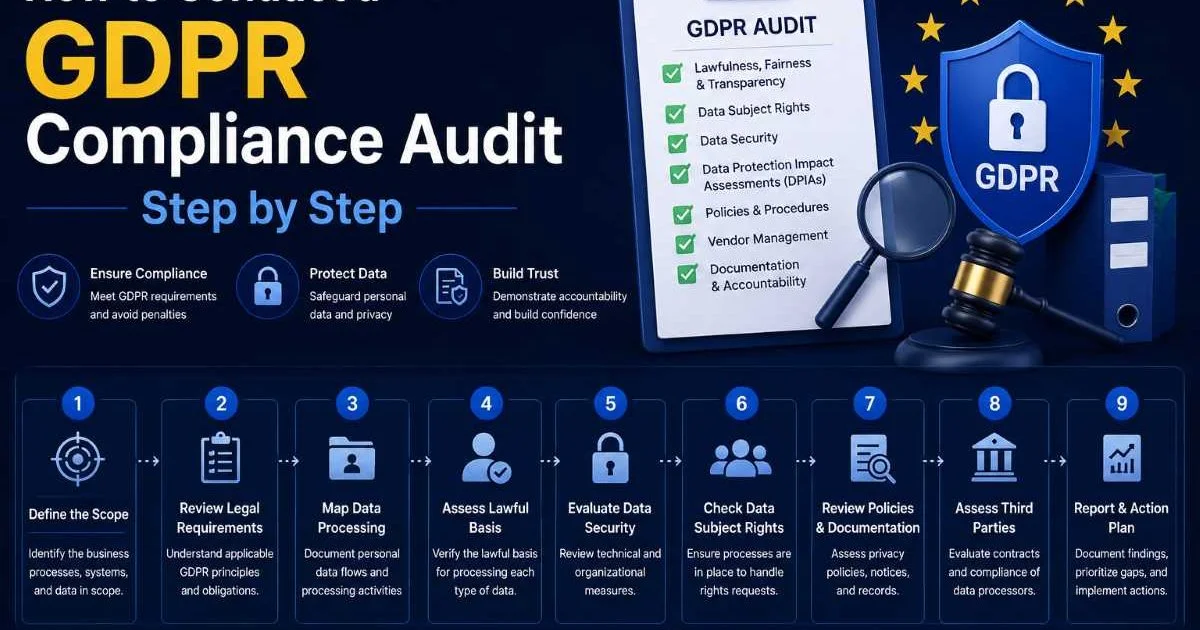
Your GDPR audit checklist should cover every major article and requirement relevant to your operations. At minimum, include items for lawful basis verification (Article 6), consent management (Article 7), data subject rights procedures (Articles 15 to 22), breach notification readiness (Articles 33 and 34), and Data Protection Impact Assessments (Article 35). Each item should have a clear pass/fail or maturity rating criteria so results are consistent across reviewers.
Avoid the common mistake of downloading a generic checklist from the internet and treating it as final. Every organization is different; a healthcare provider needs items around special category data that a SaaS company might not. Tailor your checklist to reflect your actual processing activities. At the end of this step, you should have a scoped audit plan, a named team, and a customized checklist ready for fieldwork.
Generic checklists often omit sector-specific requirements like ePrivacy rules for electronic communications.

Step 2: Map Data Flows and Processing Activities
Create a Data Inventory
Data mapping is the foundation of any meaningful audit. You cannot assess compliance if you don't know what personal data you hold, where it lives, how it moves, and who can access it. Start by interviewing process owners in each department and reviewing existing Records of Processing Activities (ROPA) if they exist. Many organizations discover significant gaps at this stage, finding databases or spreadsheets with personal data that nobody formally documented.
For each processing activity, record the categories of personal data involved, the data subjects (customers, employees, website visitors), the purpose of processing, the legal basis relied upon, and the retention period. This is a legal requirement under Article 30 and forms the backbone of your audit evidence. Use a centralized tool or spreadsheet that multiple team members can update. Inconsistent records across departments will undermine the entire exercise.
Identify Third-Party Processors
Third-party data processors represent one of the biggest risk areas. List every vendor, cloud provider, analytics platform, and subcontractor that touches personal data on your behalf. For each processor, verify that a compliant Data Processing Agreement (DPA) exists under Article 28. Check whether they transfer data outside the EEA, and if so, confirm that appropriate safeguards like Standard Contractual Clauses are in place.
Many GDPR fines have resulted from inadequate processor oversight. A well-known example is the €14.5 million fine issued to Deutsche Wohnen in 2019 for retaining tenant data without proper justification, partly due to system-level failures that spanned multiple vendors. Tools like AI agent monitoring platforms can help track how automated systems interact with personal data across your vendor ecosystem. At the end of this step, you should have a complete data inventory and a processor register with DPA status for each vendor.
Missing or outdated Data Processing Agreements are among the most common audit failures and can trigger significant penalties.
Step 3: Conduct Privacy Risk Assessment and Gap Analysis
Evaluate Risk Levels
With your data map in hand, the next step is assessing the privacy risk each processing activity poses to individuals. The GDPR takes a risk-based approach, meaning higher-risk activities demand stronger controls. Evaluate each processing activity against two dimensions: the likelihood of a data protection issue occurring and the severity of impact on data subjects if it does. Activities involving children's data, large-scale profiling, or health records will naturally score higher.
"The organizations that score lowest on risk assessments are the ones that take them most seriously."
Use a simple risk matrix to categorize each activity as low, medium, high, or critical. For any activity rated high or critical, determine whether a Data Protection Impact Assessment (DPIA) is required under Article 35. DPIAs are mandatory when processing is likely to result in a high risk to individuals' rights and freedoms. This includes systematic monitoring of public areas, automated decision-making with legal effects, and large-scale processing of special category data.
Perform Gap Analysis
Compare your current state against each item on your audit checklist. For every requirement, document whether the organization is fully compliant, partially compliant, or non-compliant. Be honest here because the point of an internal audit is to find problems before a supervisory authority does. Common gaps include outdated privacy notices, consent mechanisms that don't meet GDPR standards (pre-ticked boxes still appear more often than you'd think), and missing procedures for handling data subject access requests within the 30-day deadline.
Don't just look at policies on paper. Test whether those policies work in practice. Send a mock data subject access request to your customer service team and see what happens. Check whether your breach notification process can actually deliver an alert to the supervisory authority within 72 hours. Practical testing reveals weaknesses that document reviews alone will miss. At the end of this step, you should have a scored risk register and a gap analysis matrix showing exactly where you stand.
| Audit Area | Common Gap | Risk Level | Typical Remediation Time |
|---|---|---|---|
| Consent Management | Pre-ticked boxes or bundled consent | High | 2 to 4 weeks |
| Data Subject Rights | No formal SAR response procedure | High | 3 to 6 weeks |
| Breach Notification | No 72-hour escalation workflow | Critical | 4 to 8 weeks |
| Privacy Notices | Outdated or missing information | Medium | 1 to 2 weeks |
| Processor Agreements | Missing or unsigned DPAs | High | 4 to 12 weeks |
| Data Retention | No defined retention schedules | Medium | 6 to 10 weeks |
Involve frontline staff in gap analysis interviews; they often know about informal data handling practices that management overlooks.
Step 4: Document Findings and Build a Remediation Plan
Structure Your Audit Report
Your audit report is both a compliance artifact and a management tool. Structure it with an executive summary, methodology description, detailed findings by audit area, risk ratings, and recommended actions. Each finding should reference the specific GDPR article it relates to, the evidence reviewed, the current compliance status, and the recommended fix. This level of detail demonstrates the accountability principle under Article 5(2) and gives your DPO or board a clear view of organizational exposure.
Include both quantitative metrics (percentage of processing activities with valid legal basis, number of DPAs in place versus outstanding) and qualitative observations. If you discovered that your marketing team collects email addresses through a third-party form without a privacy notice, describe the specific scenario. Vague findings like "privacy notices need improvement" are unhelpful. Be precise about what's wrong and what fixing it looks like.
Retain all audit documentation for at least five years as regulators may request historical compliance evidence during investigations.
Assign Remediation Ownership
Every identified gap needs an owner, a deadline, and a priority level. Assign remediation tasks to specific individuals rather than departments. "Marketing team will fix consent forms" is vague. "Sarah Chen, Marketing Operations Lead, will implement granular consent options on all web forms by March 15" is actionable. Group remediation items by priority: address critical and high-risk gaps within 30 days, medium-risk items within 90 days, and low-risk items within the next audit cycle.
Build a follow-up review into your plan. Schedule a check-in at 30 and 60 days to verify that remediation is actually happening. Too many audits produce excellent reports that sit on a shelf while nothing changes. Consider implementing continuous monitoring rather than relying solely on annual audits. Privacy risks evolve as your business changes, new vendors are onboarded, and new products launch. At the end of this step, you should have a finalized audit report distributed to stakeholders and a remediation tracker with clear ownership and deadlines.
Audit reports without assigned remediation owners typically result in less than 40% of identified gaps being addressed within six months.

Frequently Asked Questions
?How long does a GDPR compliance audit typically take to complete?
?Can I use a generic GDPR checklist downloaded from the internet?
?How is a privacy risk assessment different from a Data Protection Impact Assessment?
?What happens if remediation ownership isn't assigned after the audit?
Final Thoughts
A well-executed GDPR compliance audit protects your organization from regulatory fines, reputational damage, and the real harm that data breaches cause to individuals.
The process outlined here, from scoping and checklist creation through data mapping, risk assessment, and remediation planning, gives you a repeatable framework you can run annually or whenever significant changes occur. Don't treat the audit as a one-off checkbox exercise. Make it a living part of your privacy program, and you'll stay ahead of regulatory expectations while building genuine trust with the people whose data you handle.
Disclaimer: Portions of this content may have been generated using AI tools to enhance clarity and brevity. While reviewed by a human, independent verification is encouraged.